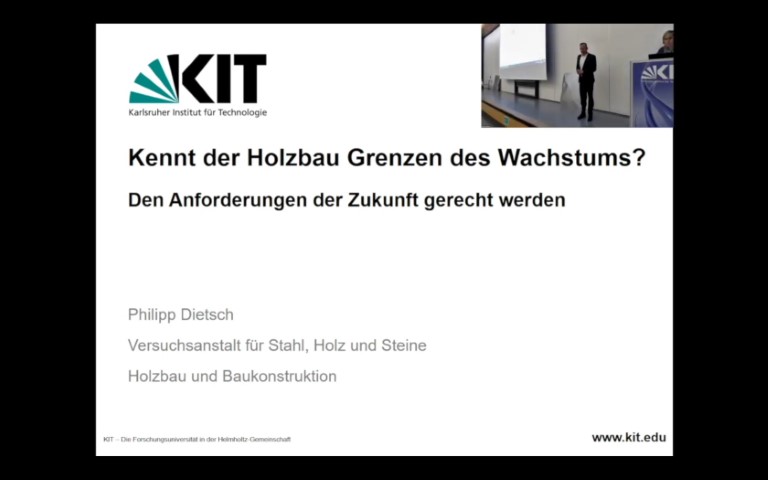

Timber construction is developing rapidly – new technical possibilities are opening up previously unthinkable dimensions and areas of application. However, this growth also brings challenges. The "Karlsruher Tage - Holzbau 2026" provided a forum for the necessary exchange between research and practice on the opportunities and hurdles facing the sector.
Particularly pleasing: the Prof. Blaß University Prize was awarded to Antonia Schoch. The presentations covered current topics such as earthquake resistance, circular construction and innovative timber-hybrid high-rises – offering fresh insights and featuring 40 % female speakers.
The positive response has bolstered plans for the Karlsruher Tage 2028 – combining time-honoured traditions with new perspectives.
Post on LinkedIn
We, KIT Timber Structures and Building Construction, are currently looking for an experienced person to join our secretarial team who enjoys a wide range of tasks, including:
- Independent and autonomous management of the institute's secretarial office
- International communication and correspondence
- Organisation of conferences and other events for the institute
- And much more ...
If you have completed commercial training (e.g. office management assistant, administrative assistant) or have comparable training or demonstrable knowledge at the appropriate level, then we would be delighted to receive your application.
For further information, please refer to the official KIT job advertisement.
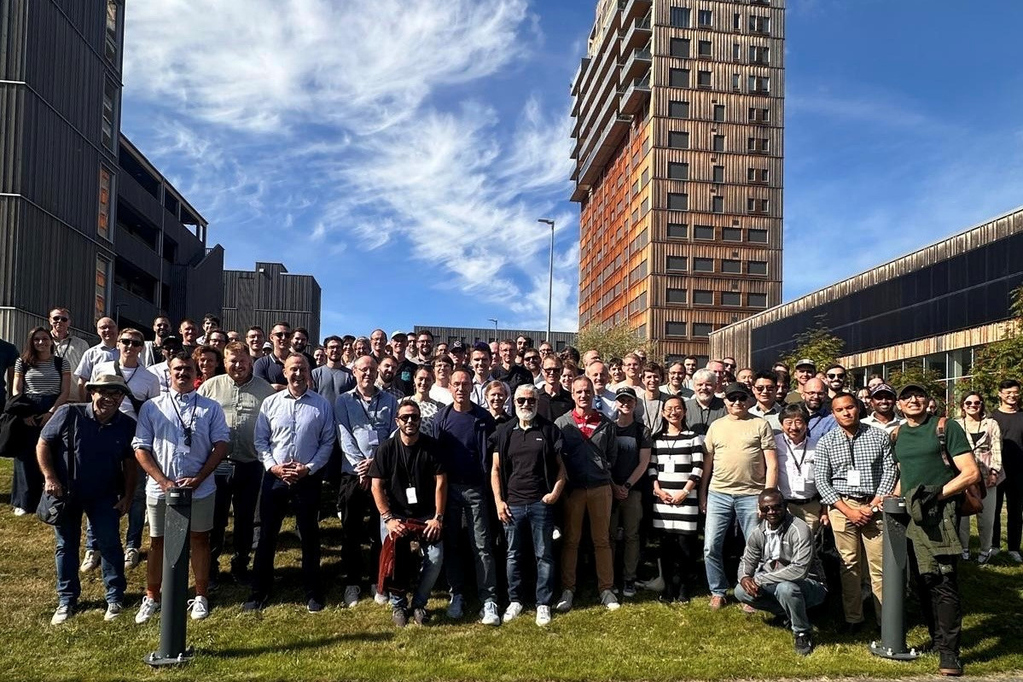
This year's meeting of the International Network on Timber Engineering Research (INTER) took place at the Norwegian University of Life Sciences (NMBU) in Ås, Norway, and was hosted by Roberto Tomasi and his team. The meeting was attended by 92 researchers and innovators from 19 countries across four continents, who came together to exchange knowledge and contribute to standardisation for timber structures.
Highlights included a conference dinner at the historic timber-framed ‘Odd Fellow’ building in Ski, as well as an excursion to Mjøstårnet, the Viking ship and the Da Vinci Bridge. A new peer-review process has further improved the quality of the papers, and the conference proceedings will now be available as open-access publications from the day of their release. Next year’s INTER conference will take place at UBC in Vancouver, Canada.
Post on LinkedIn
At the end of August, we had the honour of hosting the 11th PhD Colloquium on Timber Engineering Research here in Karlsruhe. Three of our PhD students gave presentations at the event:
- Lukas Paul: Effect of assembly procedures on the load-bearing capacity of steel-to-timber joints with inclined screws
- Jonas Frohnhöfer: Mechanical Behavior of Post-Installed Timber-Concrete Connections
- Kay Ackermann: Investigations on influential parameters on the mechanical properties of CLT elements with large gaps
The event provided an excellent opportunity to exchange ideas, brainstorm and identify potential synergies with colleagues from the University of British Columbia, Tongji University, TU Graz, TU Munich, ETH Zurich and Aalto University. The presentations covered a wide range of topics in the field of timber engineering and sparked many interesting discussions throughout the event. Many thanks to all the participants who contributed significantly to the success of the event!

Congratulations to Elisabet Kuck on being awarded the Fritz-Peter-Müller Foundation Prize in recognition of the outstanding achievements in her PhD thesis. In her thesis, entitled “Failure Behaviour of Fasteners in Timber Connections – Testing Approaches for Laterally Loaded Dowel-Type Fasteners”, she investigated the load-bearing and failure behaviour of fasteners subjected to shear stress in softwood and hardwood.
We would also like to congratulate Bruno Blattert on being awarded the prize by the “Freunde der Versuchsanstalt für Stahl, Holz und Steine e.V." for his Master’s thesis entitled “Investigations on the load-carrying capacity of hybrid timber-steel pinned-columns”.
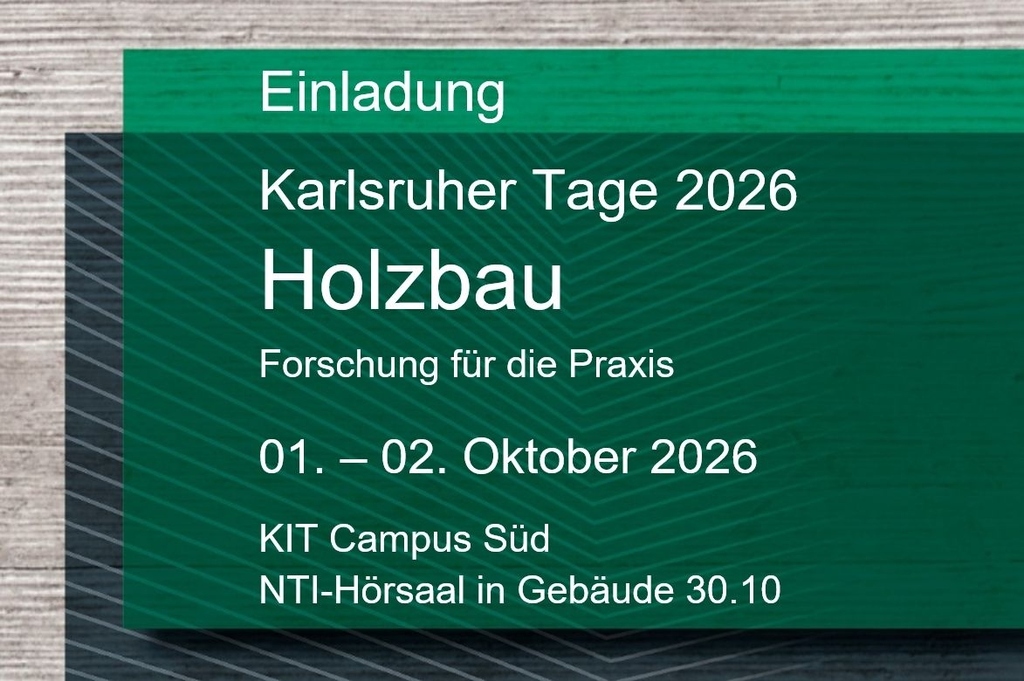
On October 1 and 2, 2026, the Karlsruhe Days at KIT in Karlsruhe will once again provide a forum for exchange between research and practice in timber construction. This long-standing conference presents the latest developments in research, standardization, and construction practice.
This year’s program focuses on new findings regarding connections in timber construction, including the load-bearing behavior of dowel-type fasteners in hardwood and the determination of the torsional stiffness of bolted connections. In addition, the future regulations for the design of connections in Eurocode 5, new approaches to seismic design, and requirements for the robustness of timber structures will be presented.
Other presentations will address moisture protection during the construction phase, the KARLA high-rise timber building in Karlsruhe, and current practical examples of circular construction and the reuse of timber components.
▶ Further Information and Registration
Post on LinkedIn
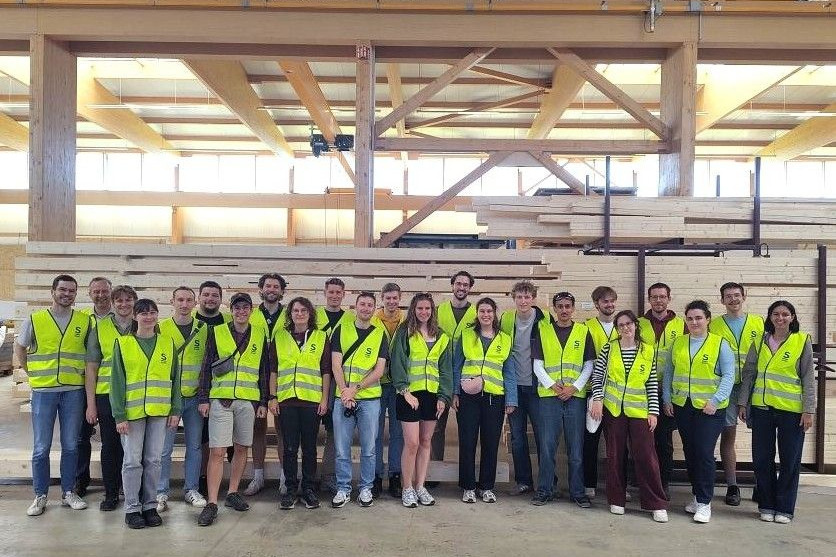
As part of the Master’s program in Structural Engineering at KIT we organized an excursion to Hamburg that combined theory with practice. Thanks to our partners our students gained exciting insights into sustainability in engineering through innovative construction projects—from the U5 subway line and modular timber construction to Hamburg’s first zero-emission building and a boat tour with the Hamburg Port Authority. Spending these days with our students was one of the highlights of the year. Curious, dedicated, and open-minded—we are convinced that they have everything it takes to become excellent structural engineers. We also hope that many of them will become future ambassadors for innovative and sustainable structural engineering.
Special thanks go to Jonas Frohnhöfer and Lukas Paul for organizing these extraordinary days. We also thank all of our host companies for generously sharing their insights, expertise and enthusiasm with us.
You can find the LinkedIn post here.

The climate crisis and resource scarcity are shifting the focus toward the circular use of wood. But how can existing materials be transformed into a reliable building product?
The symposium organized by the Faculty of Architecture at KIT discusses the necessary steps to achieve this: identifying donor buildings, harvesting wood in a manner suitable for demolition, conducting contaminant analyses, performing mechanical evaluations, and sorting and processing the wood for structural use. Experts from research and practice will present methods, experiences and examples through lectures, project reports and discussions, linking design, construction and material cycles. The event offers a platform for exchange between theory and practice.
▶ Further Information und Registration
You can find the LinkedIn post here.
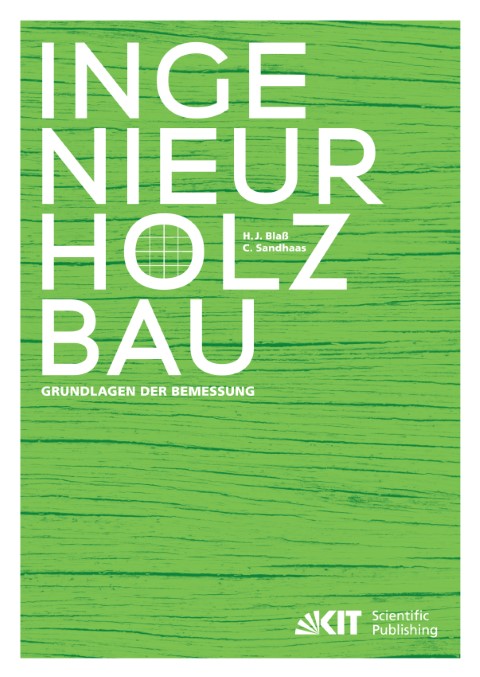
Reference book
Download PDF